
Category: Books by Andrew D. Miles
-
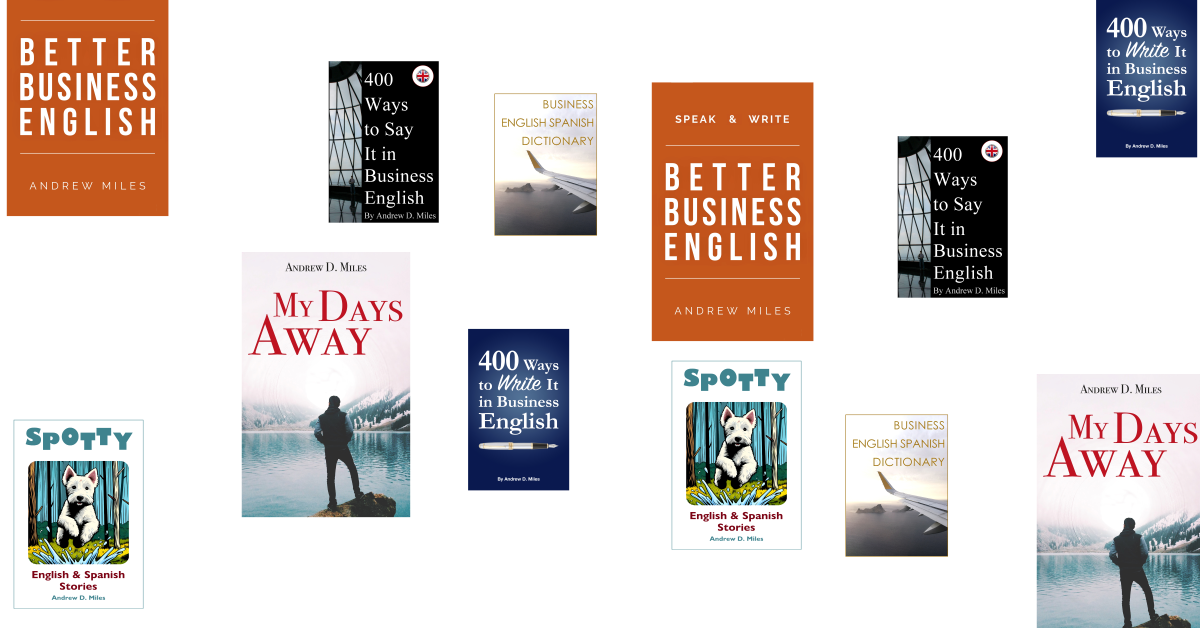
When you are a foreigner speaking a new language, visual information will make your message clearer. However, it must follow some rules. Easy understanding Easy reading and listening Easy anticipation Have a look at Andrew’s book on how to improve your business English: www.andymiles.com
-
CONSTRUYENDO NUEVAS PALABRAS —Tengo una duda, Teacher. ¿Hay alguna manera fácil de ampliar mi vocabulario? —me preguntó un alumno. —Puedes construir palabras—respondí. —¿Cómo? —Si conoces un vocablo, por ejemplo, time, es posible formar timer. Si sabes react, puedes componer reaction. ¡Y si conoces know, puedes hacer knowledge! Has duplicado tu léxico con poco esfuerzo. —Interesante.…
-
Have you ever attended lessons where the tutor invariably asks you to describe your weekend? Conversation in class should be varied because life is varied. There are more scenarios than weekends! Complaining, presenting information, discussing delivery terms, talking about finance, asking for a discount and many others. Unfortunately, classroom time is limited so it’s advisable…
-
There are many ways in which you can improve your English for free. Here’s a list with some:
-
Do you need to explain that there’s about half the chance something happens? Use the auxiliary “could” or these adverbs: “perhaps, possibly, maybe.” The story behind this tip It was 1991. I was helping the financial manager of a German company with a presentation to his group director in Dusseldorf. It was an important meeting…
-
Better business English: Make sure people understand what is important Foreign language students sometimes find it hard to get listeners to comprehend everything they say. Here are some techniques you can use: Is it vital? Say so People are not listening all the time so introduce important points with the right words, such as “This…
-
If you are not sure whether your English is getting better, ask yourself three questions: Can I define what I learnt today? People should be able to remember exactly what they study in each class. If the answer is “We talked about many things but I can’t remember even one new word” something is not…
-
Writing what your teacher says is the easiest way to learn a language. Keep a notebook and record explanations, expressions, difficult sentences or anything else you find interesting. Writing improves your focus. When we take notes, we don’t have time to waste and lessons instantly become more effective. We need to listen to write what…
-
Have you ever attended lessons where the tutor invariably asks you to describe your weekend? Conversation in class should be varied because life is varied. There are more scenarios than weekends! Complaining, presenting information, discussing delivery terms, talking about finance, asking for a discount and many others. Unfortunately, classroom time is limited so it’s advisable…
-
Go for private classes or small groups There is an inverse relation between class size and learning speed. Conversation is essential to learn a language and speaking for more than just a few minutes is almost impossible in large groups. Also, it is difficult to get individual attention in a big class so problems that…